Home Author
Author

NextRiddle

Only the Sharpest Eyes Will Find Them All

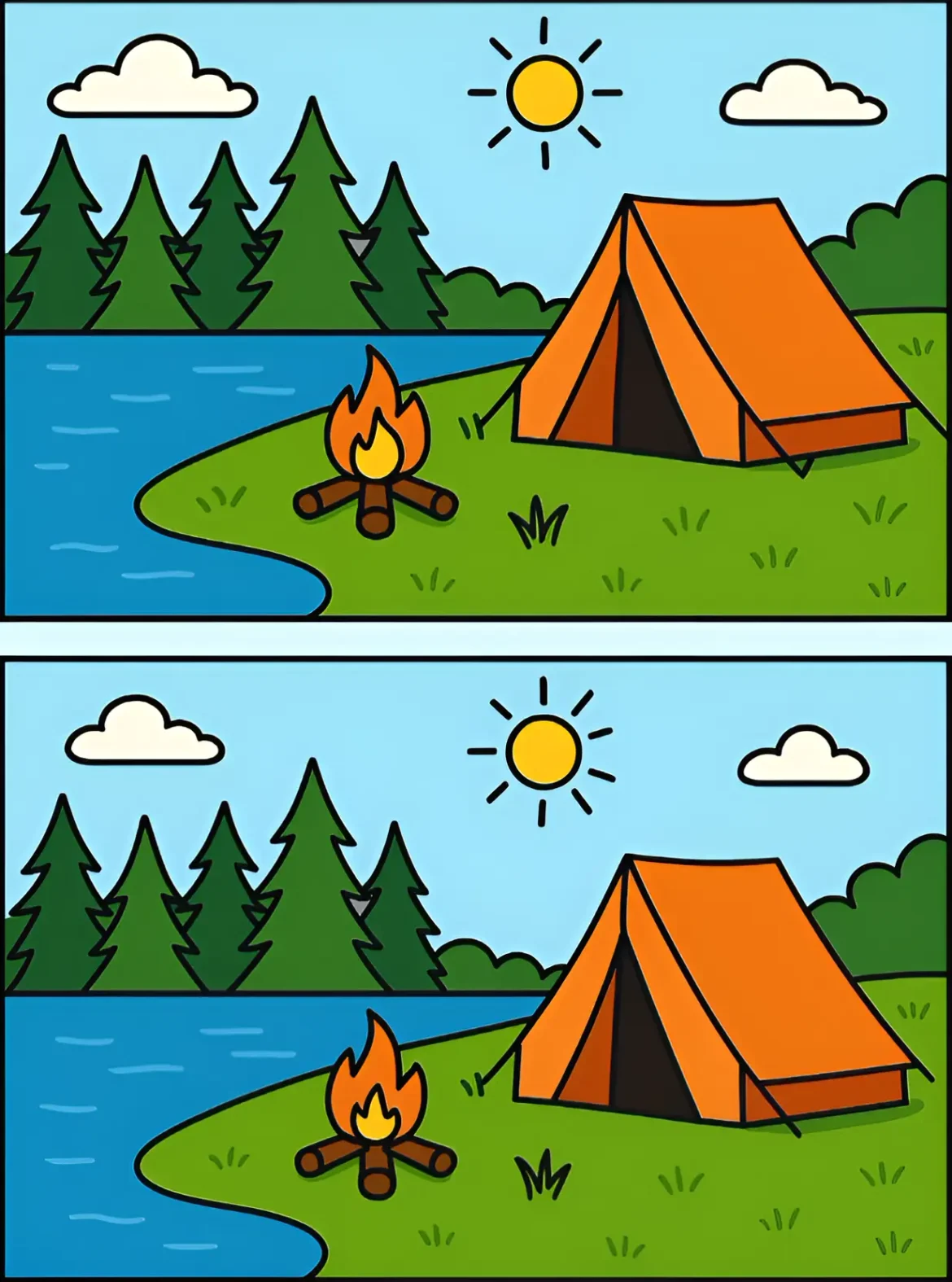
At first glance, these two camping scenes look exactly the same. A peaceful lake, trees in the background, a tent, and a small campfire—everything seems identical. But don’t be fooled. There are actually 7 differences hidden between the two images.

Most people jump into the challenge and quickly spot a couple of differences. Maybe three if they focus. But finding all seven? That’s where it gets interesting. In fact, only a small percentage of people manage to find them all without help.

Why This Puzzle Is So Tricky

The difficulty comes from how natural the scene feels. Your brain quickly recognizes the setting and assumes everything is the same. That’s exactly what makes this puzzle challenging. The differences are subtle and spread across the image, forcing you to carefully scan every detail.

Some changes are obvious once you notice them, while others are extremely easy to miss. You might find yourself checking the same areas again and again, thinking you’ve already looked everywhere—until suddenly, a new detail pops out.

The Challenge Behind the Numbers

Most people can find 3 differences without much effort. That’s normal. But reaching all 7 differences requires patience, focus, and a sharp eye for detail.

It’s not about rushing—it’s about observing. The smallest elements, like shapes, lines, and tiny objects, often hold the key.

The Solution

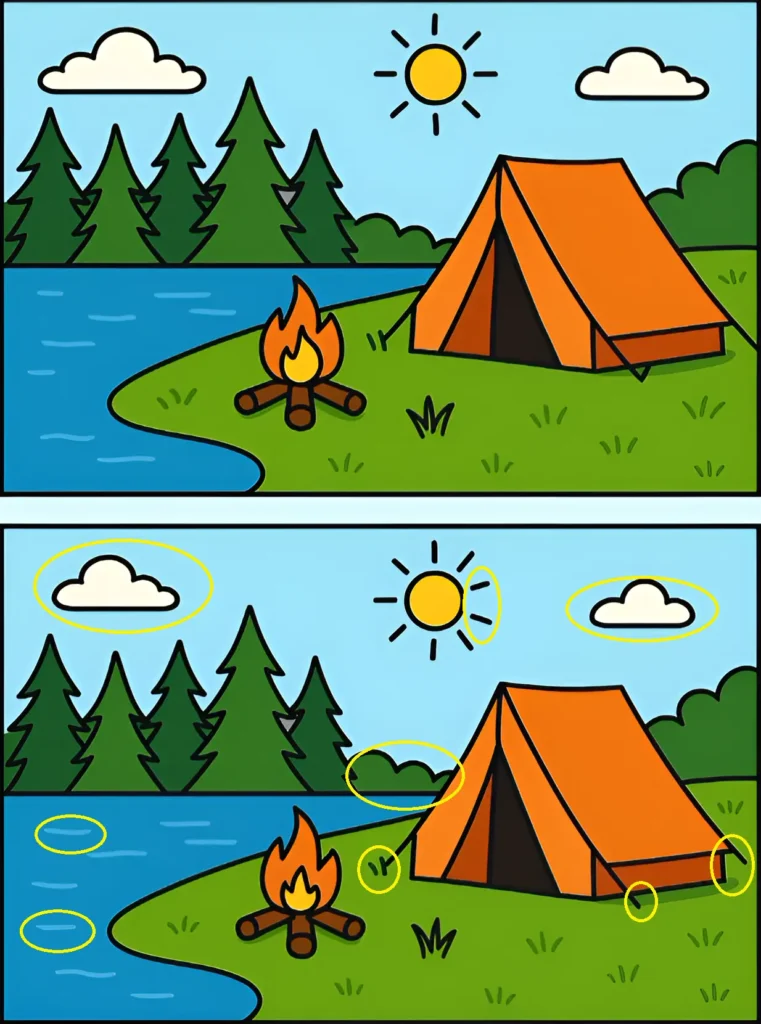
If you couldn’t find all of them, here are the 7 differences:

  • Both clouds are different
  • The sun has a change
  • The campfire is different
  • The tall grass between the campfire and the tent is different
  • The water waves are not the same
  • The guy-line peg of the tent is missing in one image
Conclusion

This puzzle is a great reminder that small details can easily escape our attention. By slowing down and observing carefully, you can train your eyes to notice what others miss.

So… how many differences did you find? Were you part of the few who spotted all 7?
6 views
0 FacebookTwitterPinterestEmail

A Simple Image That Challenges Your Eyes

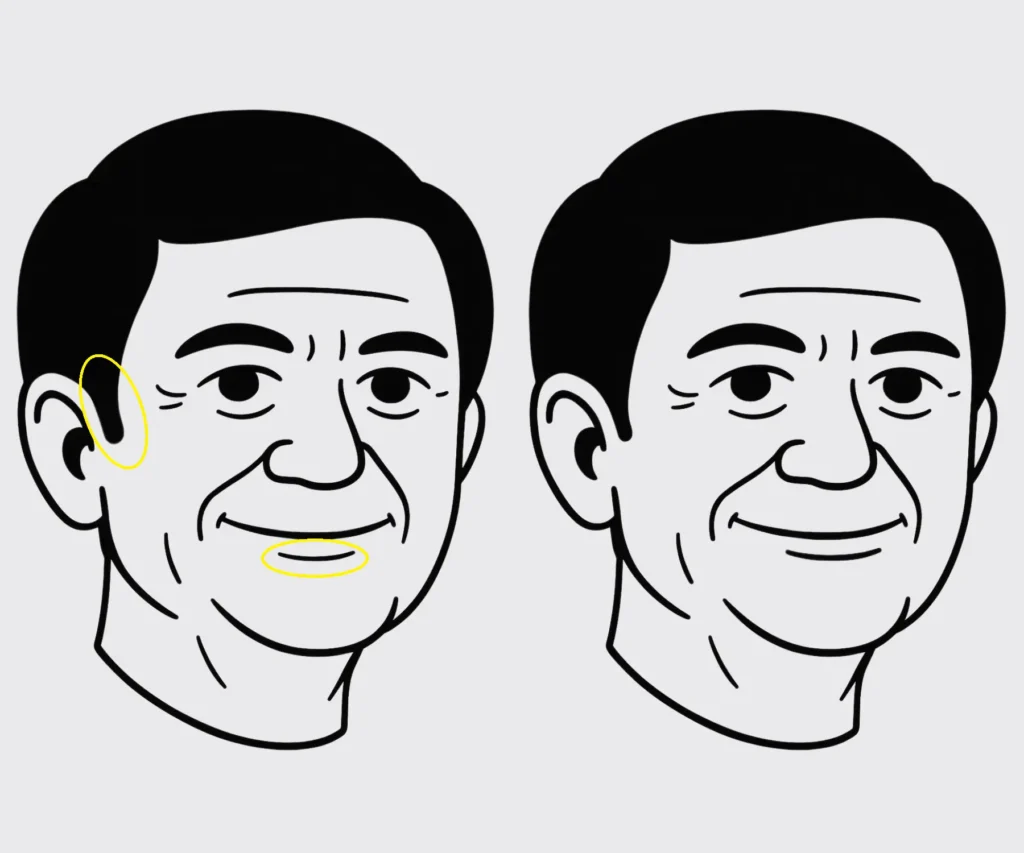
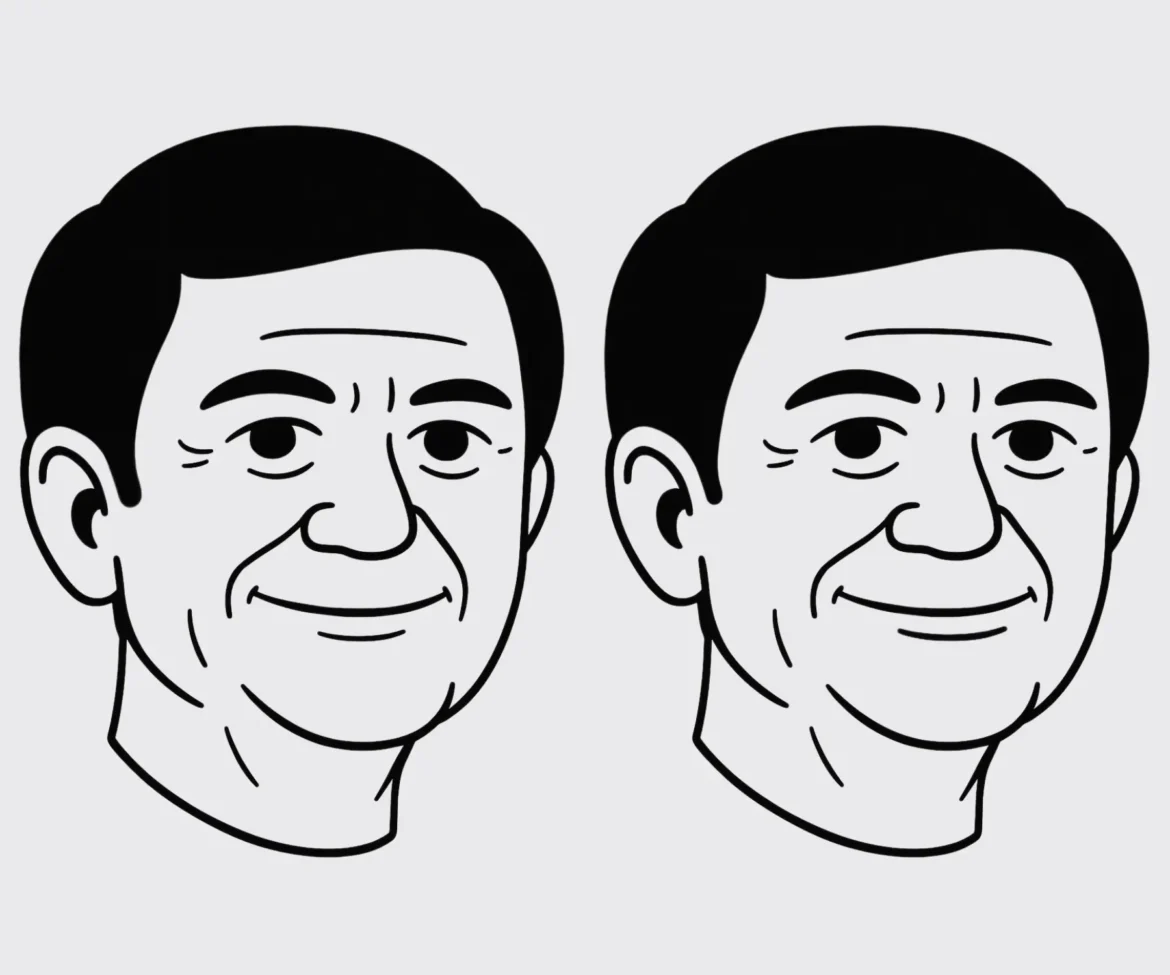
At first glance, these two faces look exactly the same. Same expression, same features, same style. But don’t be fooled—there are two small differences hidden in the image.

Spot-the-difference puzzles like this are designed to test how carefully you observe details. Your brain quickly recognizes the overall face and assumes everything matches, but the real challenge is in the tiny details.

Why It’s Harder Than It Looks

The difficulty comes from how subtle the changes are. Nothing obvious jumps out at you. Instead, the differences are hidden in small lines and shapes that your brain tends to ignore.

Most people scan the eyes, nose, and mouth quickly, thinking they’ve checked everything. But the trick is to slow down and compare each area carefully—from the hairline to the smallest facial lines.

The Power of Careful Observation

This puzzle isn’t about intelligence—it’s about attention. The more patient you are, the easier it becomes to notice what others miss. Even a tiny change in thickness or size can be enough to hide a difference in plain sight.

Sometimes stepping away and looking again helps your brain reset and catch what it missed before.

The Solution

If you couldn’t find both differences, here they are:

  • The line under the bottom lip is different—one is shorter while the other is longer.
  • The hairline near the ear has a different thickness between the two images.

Once you notice these details, they become obvious—but they’re easy to miss at first glance.

Conclusion

This puzzle shows how small details can completely change what we see. By slowing down and paying attention, you can train your eyes to catch even the smallest differences.

So… did you spot both before seeing the answer?

5 views
0 FacebookTwitterPinterestEmail

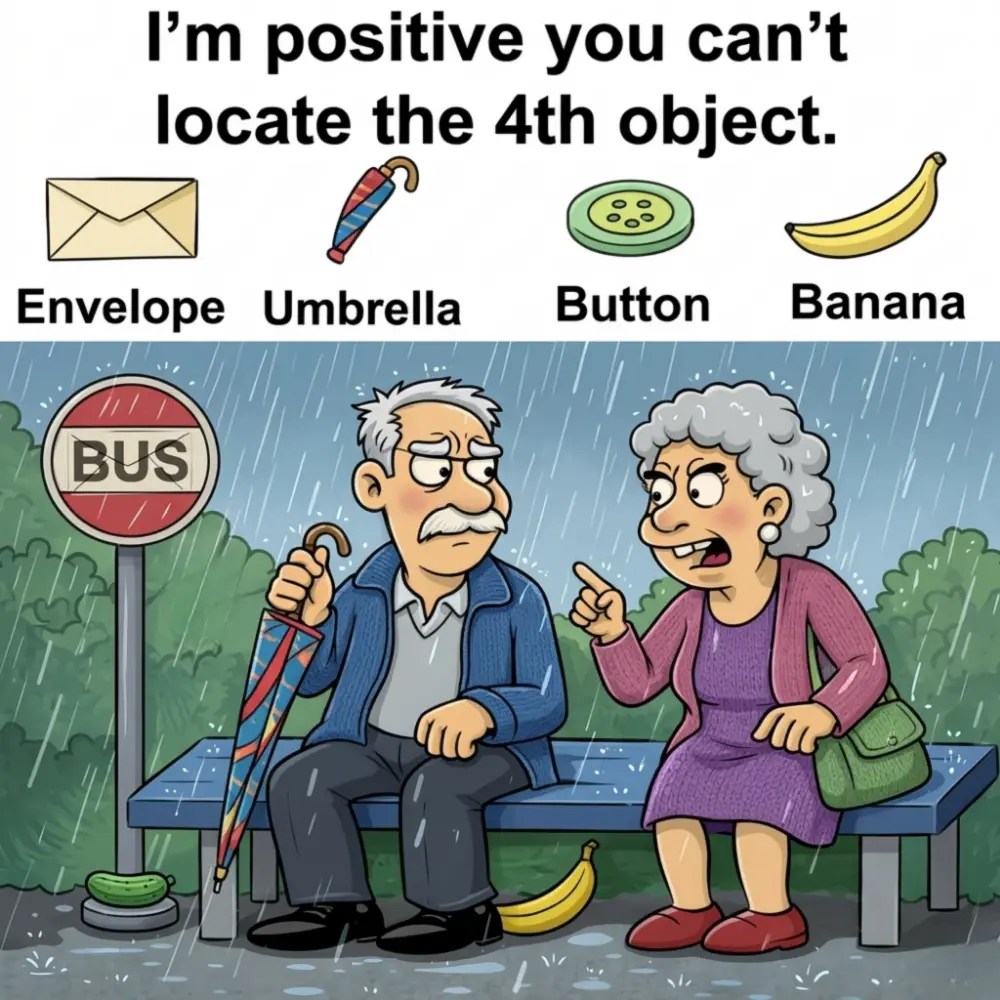
Hidden object puzzles are fun because they turn an ordinary scene into a visual challenge. In this image, we see two older people sitting at a rainy bus stop, but hidden inside the illustration are four objects: an envelope, an umbrella, a button, and a banana.

At first, the picture looks simple. Your eyes go straight to the people, the bench, and the rain. But that’s exactly why puzzles like this work so well. The hidden objects are blended into the scene, so you have to slow down and pay attention to the smaller details.

Some of the objects are easier to notice, while others are much harder to find. That’s what makes the puzzle enjoyable. It challenges the way your brain normally looks at images and pushes you to search more carefully.

These puzzles are satisfying because the objects are familiar, but they are placed in unexpected ways. What looks normal at first can suddenly reveal a hidden shape once you look again.

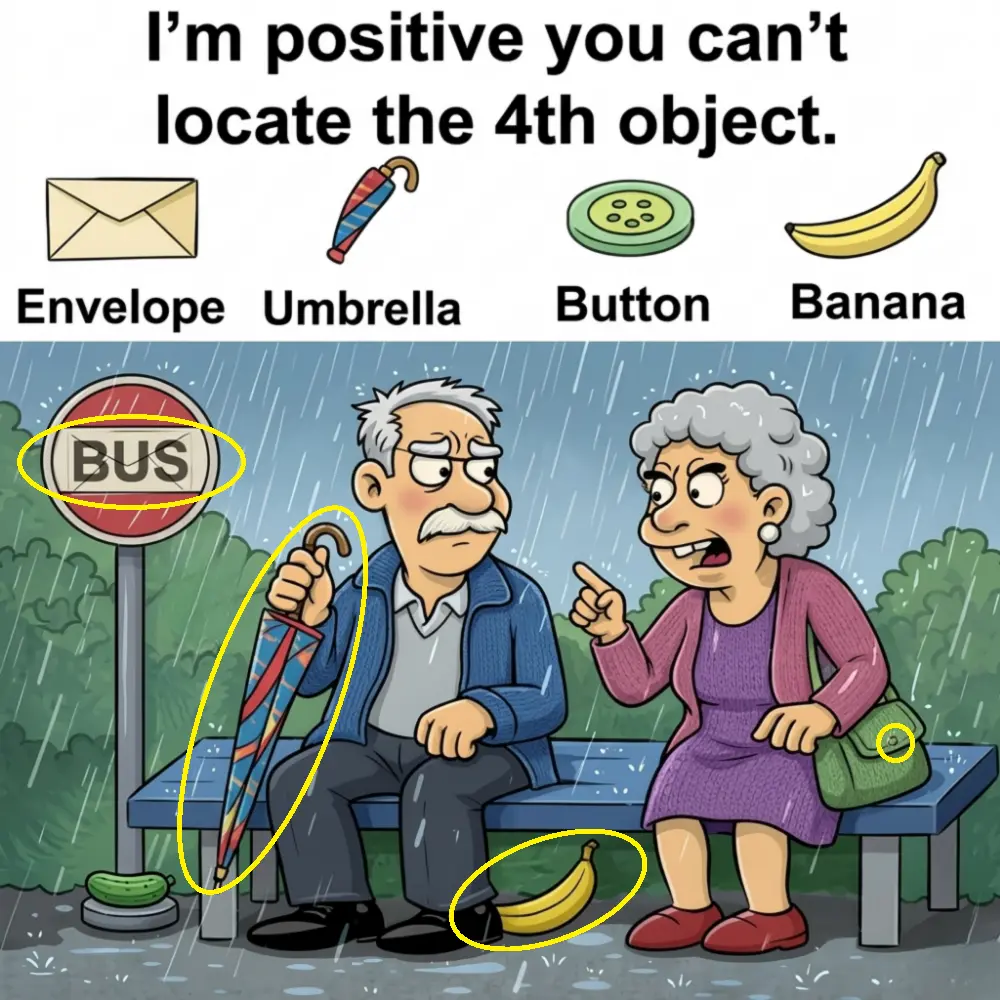
The Solution

If you could not find them all, the solution image makes everything clearer. The umbrella is easy to recognize in the man’s hand, and the banana is visible near the bench. The remaining hidden objects are blended more subtly into the illustration, which is why many people miss them at first. Once the answer is revealed, you can clearly see how cleverly each object was worked into the scene.

Conclusion

This puzzle is a great reminder that even the simplest drawings can hide clever surprises. Hidden object challenges like this are fun because they reward patience, curiosity, and close observation. What seems obvious at first can turn out to be much more deceptive after a second look—and that is exactly what makes these puzzles so enjoyable.

9 views
0 FacebookTwitterPinterestEmail

A Hidden Object Puzzle That Tests Your Eyes

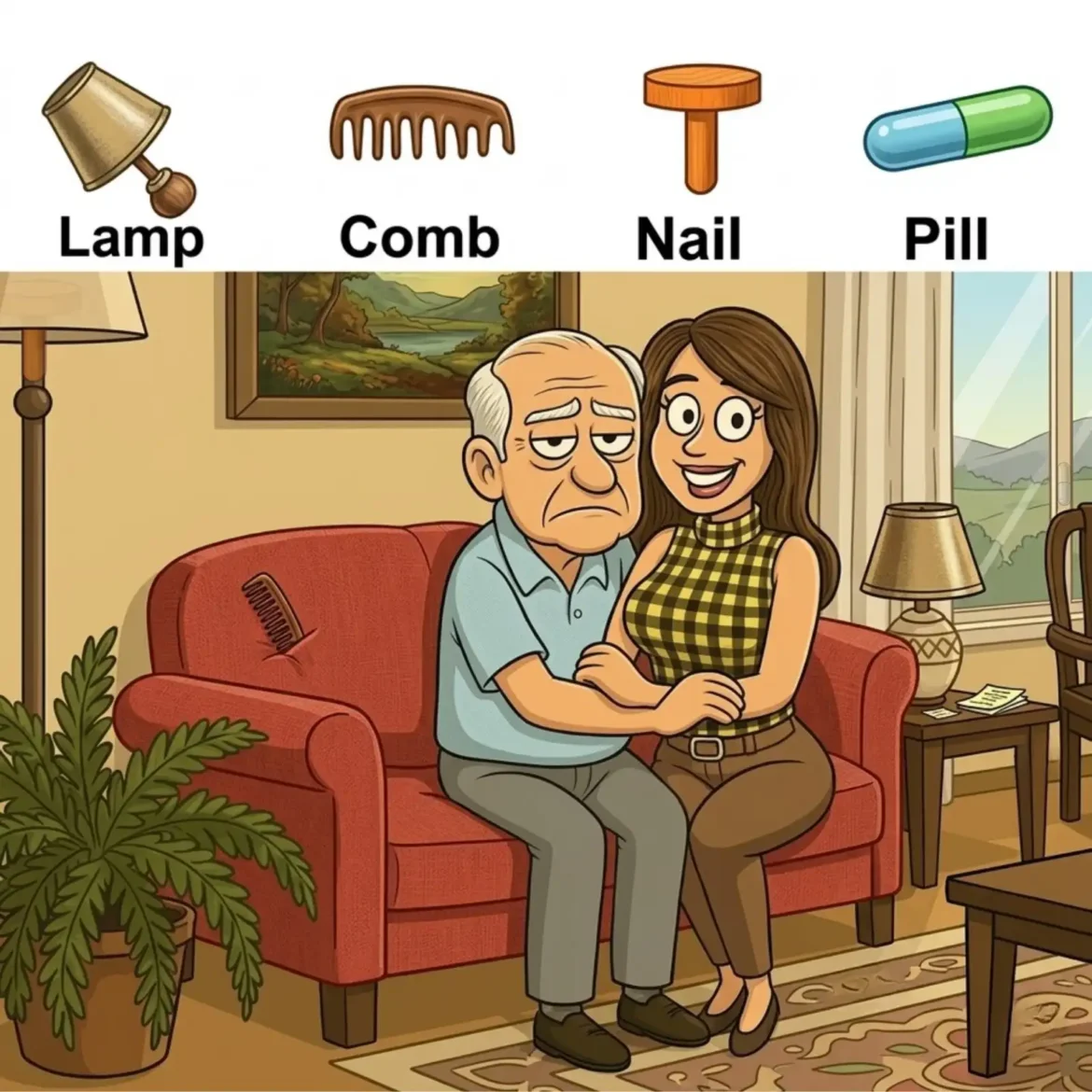
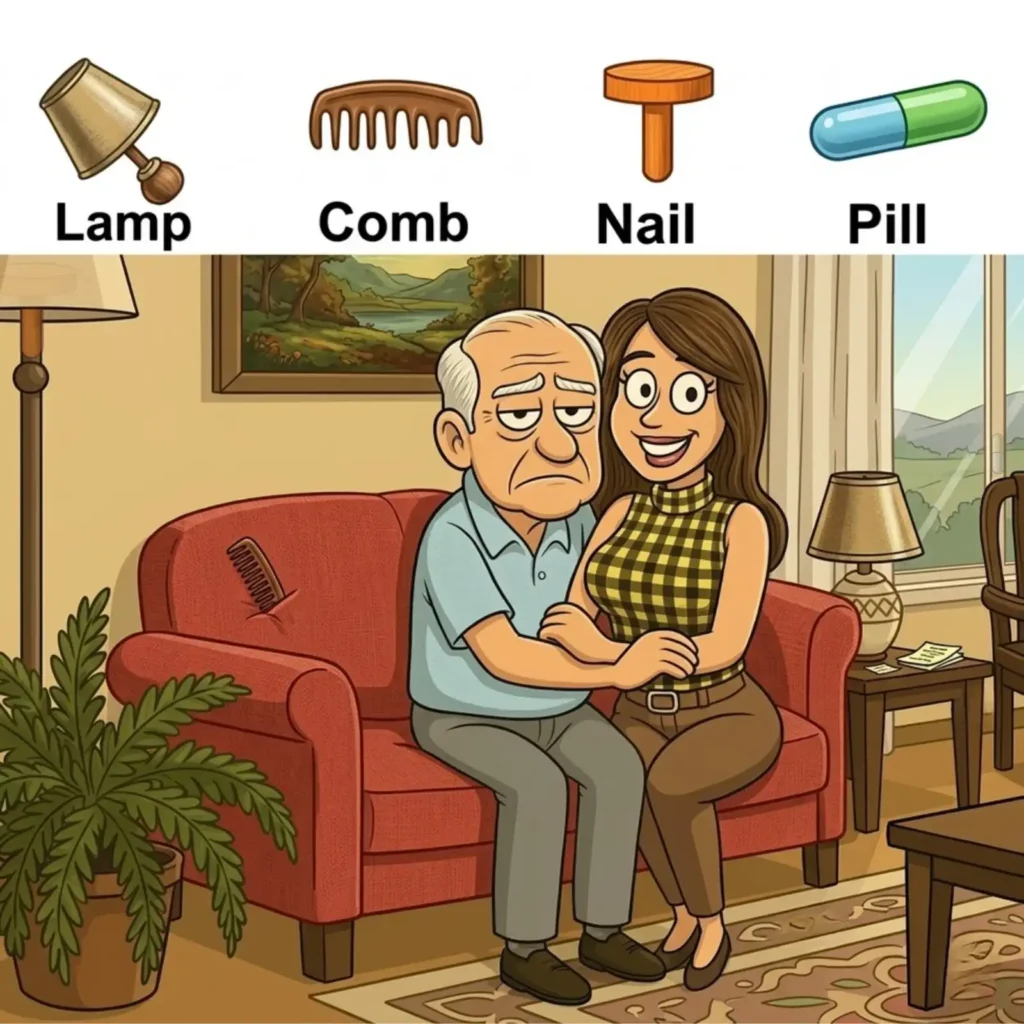
Hidden object puzzles have a way of turning an ordinary scene into a fun visual challenge. At first glance, this image looks like a simple living room illustration with two people sitting on a couch. But once you look more closely, you realize there’s much more going on. Somewhere in the picture, four objects are cleverly hidden: a lamp, a comb, a nail, and a pill.

What makes puzzles like this so enjoyable is how they play with the way we naturally see images. Most of the time, our brains focus on the big picture first—the characters, the furniture, the background, and the general setting. We usually don’t stop to inspect every small line or shape. That’s exactly why hidden object puzzles are so effective: they force us to slow down and notice details we would normally ignore.

In this image, the artist uses everyday objects and blends them smoothly into the illustration. Nothing feels random or out of place. That’s what makes the challenge interesting. The hidden items are not dropped into the scene in an obvious way—they are woven into the shapes, outlines, and parts of the environment so they feel natural. You may spot one object quickly, but the others usually take more time and patience.

The fun of this kind of puzzle comes from the process of searching. Your eyes move from the couch to the table, from the background to the clothes, and then back again as you begin to question every curve and shadow. A line that first looked decorative might actually be one of the hidden objects. A small detail in the furniture or background might suddenly reveal itself in a new way. That moment of recognition is what makes these puzzles so satisfying.

Another reason these brain teasers work so well is that the objects are familiar. Everyone knows what a lamp, comb, nail, and pill look like. The challenge is not understanding the items—it’s recognizing them when they’ve been disguised within something else. That mix of familiarity and misdirection keeps the puzzle simple to understand but tricky to solve.

This particular puzzle is also visually appealing because the scene feels calm and ordinary. The colors are warm, the room is neatly arranged, and the characters draw your attention right away. That comfortable setting makes the hidden objects even easier to miss. Your brain assumes you already understand the scene, when in reality it still has secrets waiting to be discovered.

The Solution

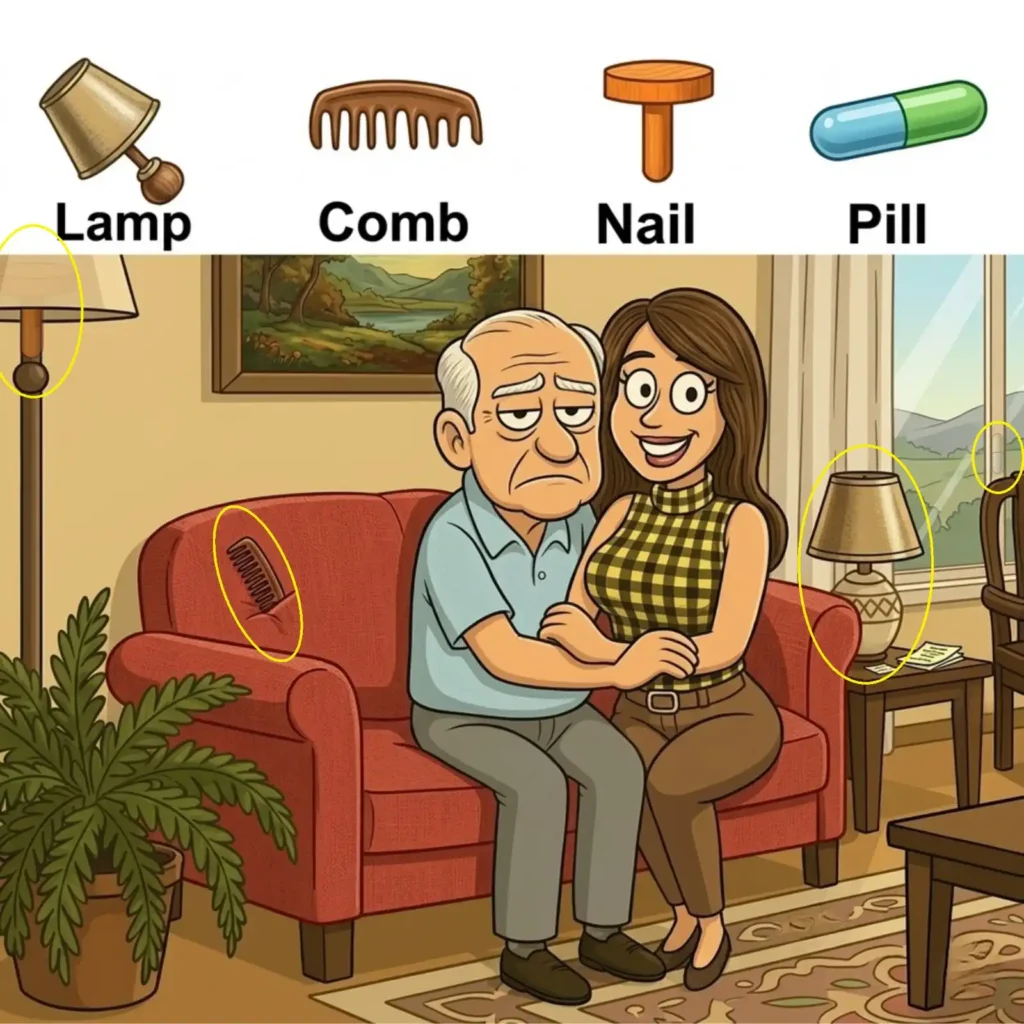
If you had trouble finding them all, the answer image reveals the hidden objects clearly. The comb is blended into the couch, while the other items are subtly incorporated into different parts of the room and background. Once the solution is shown, the hidden shapes suddenly become much easier to recognize, and you can see how cleverly the illustration was designed to hide them in plain sight.

Conclusion

This puzzle is a great example of why hidden object challenges remain so popular. They turn a simple drawing into an interactive experience, rewarding patience, focus, and careful observation. Sometimes, all it takes is a second look to discover what was there the whole time. And that’s exactly what makes these puzzles so much fun.

10 views
0 FacebookTwitterPinterestEmail

A Simple Puzzle That’s Trickier Than It Looks

Visual math puzzles have a special way of catching our attention. They look simple at first, but the moment you try to solve them, you realize there’s more going on than expected. This parrot puzzle is a perfect example. With just a man, a bird, and two measurements, it challenges you to think carefully about height, difference, and how the numbers relate to each other.

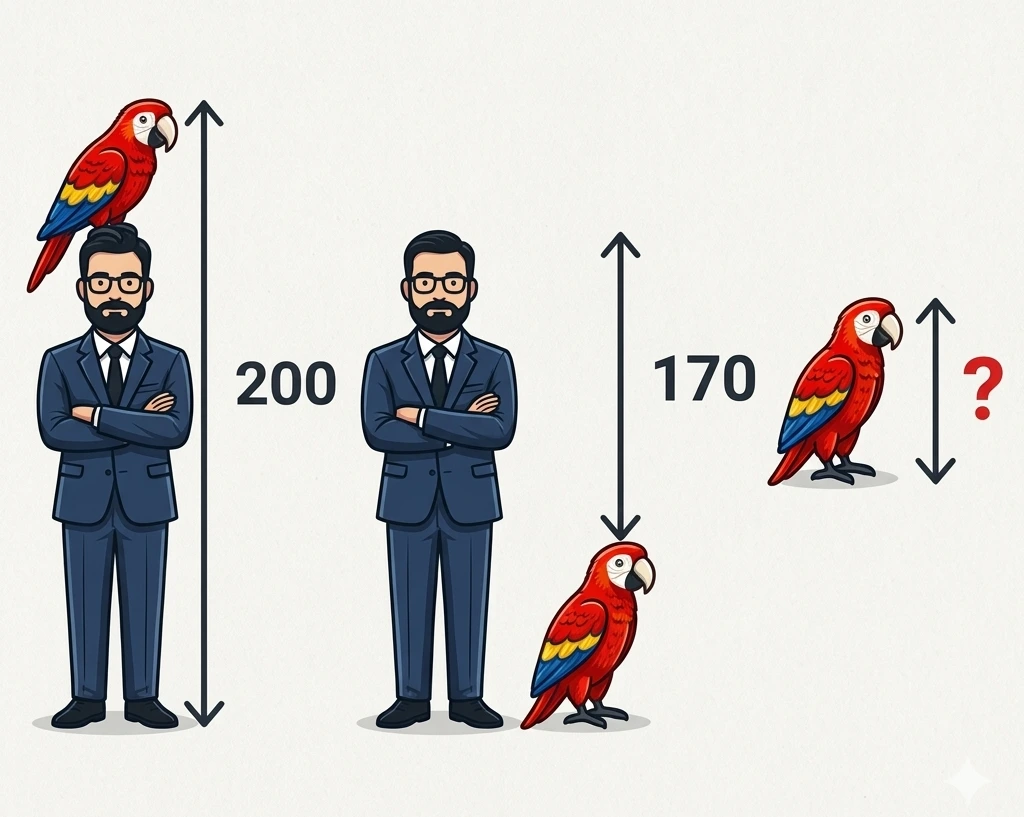
At first glance, the image seems easy to understand. In the first part, the parrot is sitting on the man’s head, and together they measure 200. In the second part, the parrot is standing on the ground beside the man, and the distance between the top of the man and the top of the parrot is 170. The big question is simple: how tall is the parrot?

What makes this puzzle fun is that it turns a basic math problem into a visual challenge. Instead of giving you an equation directly, it asks you to build the equation yourself from what you see. That’s why these puzzles are so satisfying—they combine observation with logic.

To solve it, you need to think of the man’s height and the parrot’s height as two separate values. When the parrot is on the man’s head, their heights are added together. When the parrot is on the ground, the image shows the difference between their heights. That gives you two relationships to work with, and from there the solution becomes possible.

This is where many people make mistakes. Some guess randomly, while others focus on just one number instead of using both. But the key is realizing that both measurements are connected. One represents a sum, and the other represents a difference. Once you see that, the puzzle becomes much clearer.

Puzzles like this are popular because they feel approachable. You don’t need advanced math or complicated formulas. All you need is patience and the ability to translate what you see into simple reasoning. That’s why these brain teasers work so well—they test logic in a way that feels fun instead of intimidating.

The Solution

Let the man’s height be M and the parrot’s height be P. From the first image, we know that M + P = 200. From the second image, we know that M – P = 170. Adding both equations gives 2M = 370, so M = 185. Then subtracting, we get P = 15. So the parrot’s height is 15.

Conclusion

This puzzle is a great reminder that simple-looking images can hide clever mathematical thinking. By paying attention to what the measurements really mean, we can turn a visual riddle into a clear answer. That’s what makes puzzles like this so enjoyable—they reward careful thinking and give you that satisfying “aha” moment when everything clicks.

11 views
0 FacebookTwitterPinterestEmail

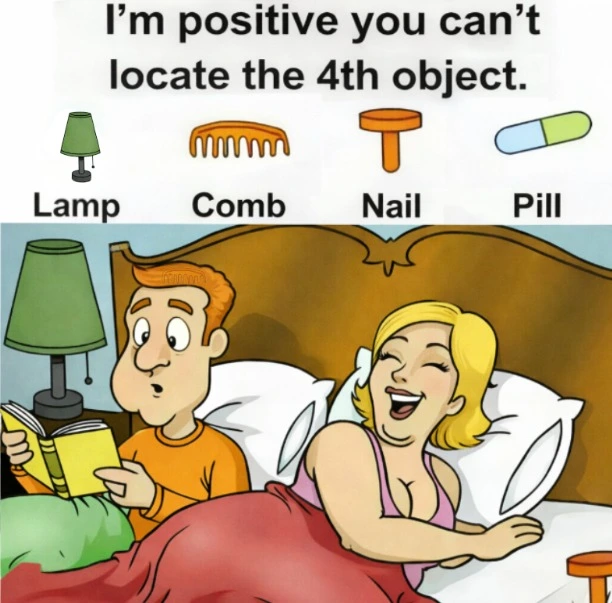
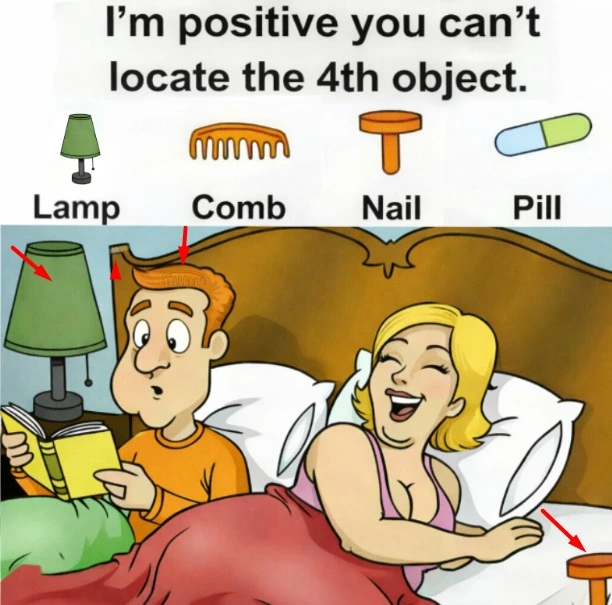
At first glance, this illustration feels familiar—just an ordinary bedroom scene. But hidden beneath its simplicity lies a clever challenge designed to test your observation skills. Hidden object puzzles like this transform everyday images into engaging brain teasers, where the goal is not just to look… but to truly see.

Somewhere in this scene are four objects: a lamp, a comb, a nail, and a pill. The question is—can you find them all?


The First Look Isn’t Enough

When you first look at the image, your brain quickly identifies the obvious elements: people, furniture, and the general setting. But hidden objects don’t reveal themselves that easily.

You might spot one or two items instantly, giving you confidence. Then suddenly… you get stuck. That’s where the real puzzle begins.

This is the moment where your perception shifts—from casual viewing to active searching.


The Art of Hiding in Plain Sight

The brilliance of this puzzle lies in how naturally the hidden objects blend into the scene.

  • The lamp may not be where you expect it
  • The comb could be part of a pattern
  • The nail might be hidden in small details
  • The pill is especially tricky to notice

Each one is designed to feel like it belongs, making it harder to spot.


Why Your Brain Struggles

Hidden object puzzles work because they challenge how your brain processes visuals. Instead of analyzing every detail, your mind simplifies what it sees.

That’s why you might:

  • Miss small details
  • Assume shapes are what they seem
  • Overlook what’s right in front of you

To solve it, you need to slow down and question everything.


Simple Scene, Tricky Challenge

The scene is intentionally simple, which makes the hidden objects even harder to notice. With fewer distractions, your brain feels confident—but that confidence can be misleading.

The challenge isn’t complexity—it’s attention to detail.


The Solution

If you’re struggling or just want to check your answers, don’t worry—I’ve got you covered. In this image, I’ll show you exactly where each of the four objects is hidden so you can see how cleverly they were placed.


Conclusion: The Joy of Looking Twice

This puzzle is a reminder that what we see at first glance is rarely the full picture. By slowing down and observing carefully, we begin to notice details we would normally ignore.

That’s what makes these challenges so satisfying—they reward patience, curiosity, and a second look.

So… did you find all four before checking the answer?

9 views
0 FacebookTwitterPinterestEmail

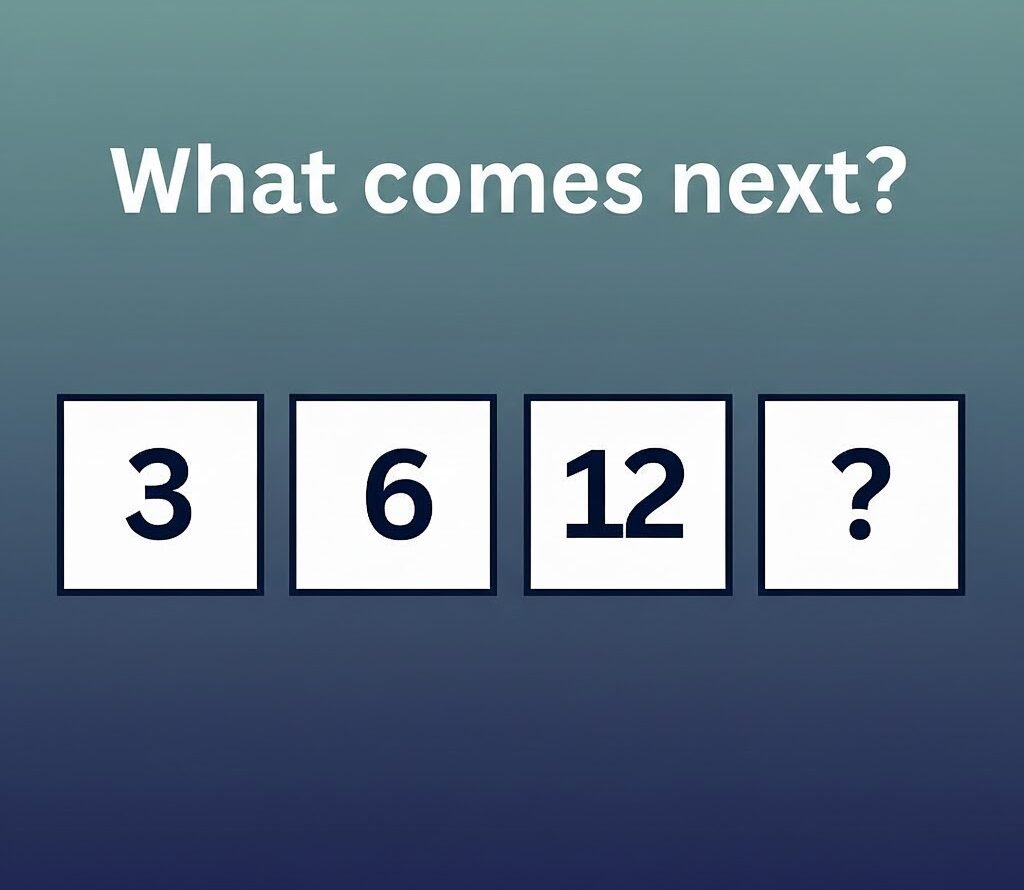
Puzzles don’t need to be complicated to make people stop, stare, and second-guess themselves. Sometimes the simplest number sequences create the most debate — especially when multiple patterns seem possible. Today’s brain teaser is a perfect example:

3, 6, 12, ?

At first glance, this sequence looks almost too easy. But the moment you ask people what comes next, the answers start to vary. Some jump to doubling, some see addition, others spot hidden patterns. So let’s break down the most common answers people give, why they think that way, and ultimately the correct solution.


💭 Possible Answer #1: “24”

This is by far the most common answer — and for good reason.
Many people notice that:

  • 3 becomes 6 (Ă—2)
  • 6 becomes 12 (Ă—2)

So naturally, the next step should be:

12 Ă— 2 = 24

This thinking is clean, intuitive, and logical. Doubling sequences appear often in puzzle books and viral riddles, so the brain jumps straight into a simple exponential pattern. Most people stop here — and honestly, it makes perfect sense.


💭 Possible Answer #2: “21”

Another group sees something different. Instead of multiplication, they notice increasing addition:

  • 3 + 3 = 6
  • 6 + 6 = 12

So they assume the pattern continues with:

12 + 9 = 21

Where does the +9 come from?
Some solvers assume the number being added increases by 3 each time:

+3 → +6 → +9

Why do people think like this?
Because number sequences often step up gradually, and this pattern feels smooth and structured. The idea of adding a growing increment is common in IQ tests and math puzzles.


💭 Possible Answer #3: “18”

Some spot yet another pattern:

  • Add 3 to get 6
  • Add 6 to get 12

So the increments are doubling: 3, 6… and next would be 12.

12 + 12 = 24 (but some think the next increment is 6 again, leading to 18)

Why does this happen?
Because the mind sometimes “resets” patterns. Instead of seeing escalating steps, some people repeat the last known change.


đź§  Why People See Different Patterns

This puzzle reveals something fascinating about how the brain works:

1. We Fill in Patterns Automatically

Humans are wired to detect repetition. When numbers look familiar or clean, the mind quickly assumes the most straightforward rule — even if multiple rules fit.

2. Simple Sequences Can Have Multiple Valid Answers

Unless a pattern is explicitly defined, different logical approaches can lead to different results. That’s why puzzles like this spark so much debate.

3. People Rely on What They’ve Seen Before

Students who’ve done IQ tests often choose “24.”
People who enjoy arithmetic patterns might pick “21.”
Your background influences your interpretation.


âś… The Correct Answer: 24

Although several answers are possible, the most mathematically consistent and widely accepted pattern is:

Each number doubles.

3 → 6 → 12 → 24

It follows a clean geometric sequence, the simplest and strongest match to the given numbers.

49 views
0 FacebookTwitterPinterestEmail

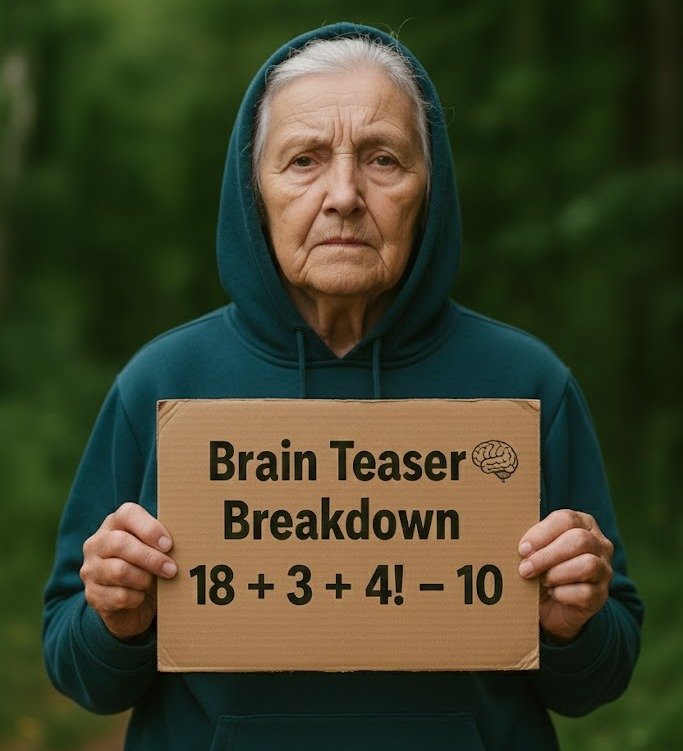
Some math problems go viral not because they’re difficult, but because they look easy and trick nearly everyone who tries them.
Today’s puzzle is exactly that kind of trap:

18 + 3 + 4! – 10

Nothing complicated here, right?
Just addition, a subtraction, and a factorial.
Except… when you post this online, you’ll still get a dozen different answers, each defended with total confidence.

Let’s explore the most common answers, why people think that way, and then the actual correct solution.


💭 Possible Answer #1: “It’s 15!”

People who get 15 usually treat the equation like a simple left-to-right addition/subtraction problem:

18 + 3 = 21
21 + 4 = 25
25 – 10 = 15

What went wrong?
They treated 4! as just 4 instead of 4 Ă— 3 Ă— 2 Ă— 1.

This happens because factorials aren’t something most people use daily — their brain quickly simplifies them.


💭 Possible Answer #2: “It’s 35!”

This one comes from doing the factorial correctly, but then mis-grouping the rest:

4! = 24
18 + 3 = 21
21 + 24 = 45
45 – 10 = 35

The mistake:
They solved correctly but forgot order matters — addition and subtraction must still be done left to right.

Many people assume that once the “big number” from the factorial is found, everything else becomes flexible.


💭 Possible Answer #3: “It’s 31!”

This group does most steps correctly, but accidentally combines operations differently:

18 + (3 + 24) – 10
18 + 27 = 45
45 – 14 = 31

The issue:
They add parentheses that don’t exist.
The equation feels long, so the brain naturally clusters it.

It’s a very human mistake — our minds love organizing things even when we shouldn’t.


đź§  Why These Mistakes Happen

1. Factorials Aren’t Intuitive

People don’t use factorials often, so when they see “4!”, the brain hesitates —
“Do I do this first? Later? Does it override the left-to-right rule?”

2. People Forget Addition/Subtraction Rules

PEMDAS/BODMAS does not say addition comes before subtraction.
They are equal in priority, so you move left to right.

For many, this memory is fuzzy.

3. Mental Grouping Changes the Equation

Our brain tries to simplify expressions by “chunking” them, even when that changes the math.


âś… Correct Answer

Let’s solve it properly:

Step 1 — Factorial first

4! = 24

Now the equation is:
18 + 3 + 24 – 10

Step 2 — Solve left to right

18 + 3 = 21
21 + 24 = 45
45 – 10 = 35


🎉 Final Answer: 35

Even the cleanest-looking equations can cause chaos when factorials jump in.
This brain teaser is the perfect example of how easy it is to rely on instinct instead of proper order of operations.

54 views
0 FacebookTwitterPinterestEmail

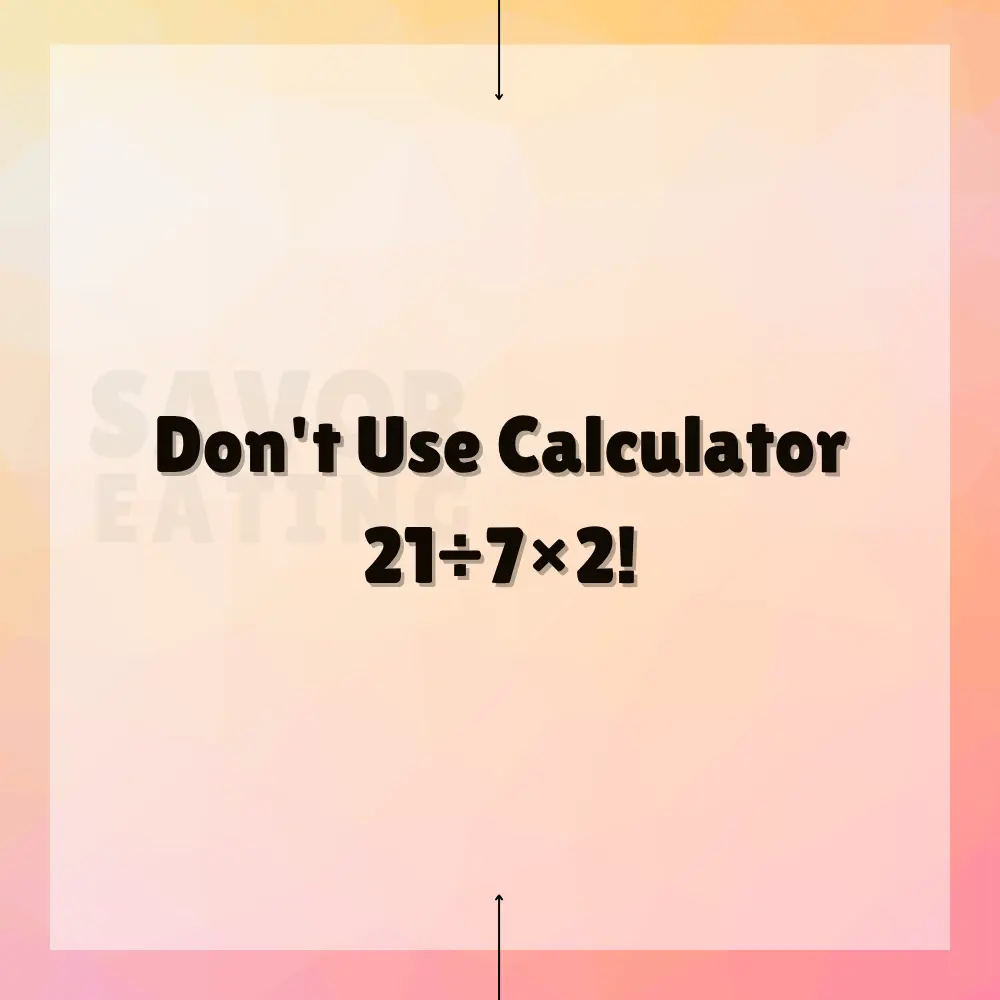
Every once in a while, a simple-looking equation pops up and suddenly your entire comments section becomes a battlefield of confident answers.
Today’s brain-teaser is:

21 Ă· 7 Ă— 2!

Looks easy, right?
That’s exactly why people get it wrong.

When factorials appear, many people switch into “fast math” mode and forget how order of operations actually works. So let’s walk through the three most common answers people usually give—plus what’s really going on.


💭 Possible Answer #1: “It’s 6!”

This answer happens when someone solves it from left to right without noticing the factorial:

21 Ă· 7 = 3
3 Ă— 2 = 6

The mistake?
They treated 2! as 2, not as the factorial of 2.


💭 Possible Answer #2: “It’s 42!”

This usually happens when someone sees the factorial and panics (just a little). They jump to:

2! = 2
21 Ă— 2 = 42
Then they divide or forget to divide at all.

This skips the left-to-right rule for division and multiplication.


💭 Possible Answer #3: “It’s 3!”

Some do the factorial correctly, but they jump ahead in the steps:

2! = 2
21 Ă· (7 Ă— 2) = 21 Ă· 14 = 1.5
Rounded or mistaken as 3, depending on how they group it.

The issue:
Adding parentheses that aren’t actually there.


âś… The Correct Answer

Let’s solve it properly using PEMDAS/BODMAS:

Step 1 — Factorial first

2! = 2

Now the equation is:

21 Ă· 7 Ă— 2

Step 2 — Division & multiplication (left to right)

21 Ă· 7 = 3
3 Ă— 2 = 6


🎉 Final Answer: 6

Another perfect example of how a simple factorial can completely change how people process an equation.

53 views
0 FacebookTwitterPinterestEmail

Every now and then, the internet stumbles upon a math problem that looks easy… but ends up dividing everyone into teams, sparking debates, and filling comment sections with confident answers that don’t match.
And this time, the troublemaker is:

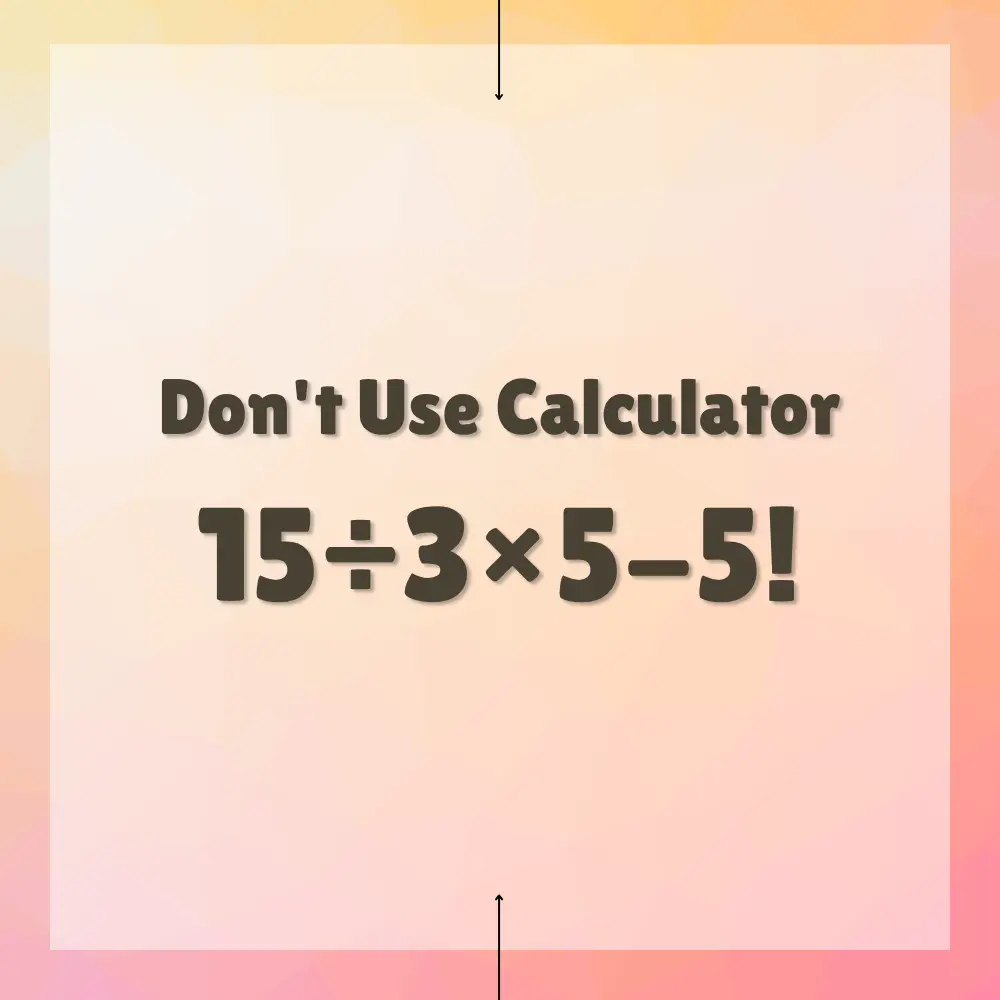
15 ÷ 3 × 5 – 5!

At first glance, it feels like a basic school-level problem. But once people start calculating, the answers explode in every direction. Why? Because factorials + PEMDAS is a combo that tricks even confident math lovers.

Let’s take a look at the most common answers people give—why they give them—and finally, the correct solution.


đź’­ The Most Common Answers People Think Are Right

1. “It’s 20!”

This is a super popular answer. People go straight from left to right:

15 Ă· 3 = 5
5 Ă— 5 = 25
25 – 5 = 20

The problem?
They treated 5! as if it were just 5. But factorials don’t play by those rules.


2. “It’s -95!” (Correct logic but wrong process)

Some people do remember that 5! = 120, but they mix up the order of the operations.
They might multiply 3 × 5 first—or reorder the steps—which leads to all sorts of incorrect results.


3. The Overthinkers

Others start adding imaginary parentheses or doing steps in a custom order because the factorial symbol makes the expression look more complicated than it really is.


✅ Now Let’s Solve It the Right Way

Step 1 — Factorials come first

5! = 120
So the equation becomes:
15 ÷ 3 × 5 – 120

Step 2 — Solve division and multiplication from left to right

15 Ă· 3 = 5
5 Ă— 5 = 25

Now we have:
25 – 120

Step 3 — Subtract

25 – 120 = –95


🎉 Final Answer: –95

This little equation is a perfect example of how people interpret math differently—especially when factorials sneak into the picture.
If you want an easy way to start a debate in your comments, this equation will definitely do the job.

88 views
0 FacebookTwitterPinterestEmail
  • 1
  • 2

Next Riddle

Spot-the-difference, hidden objects, optical illusions, and artistic puzzles that rely on sharp eyes and attention to detail.

Newsletter

Subscribe my Newsletter for new blog posts, tips & new photos. Let's stay updated!

2025 All Right Reserved.