
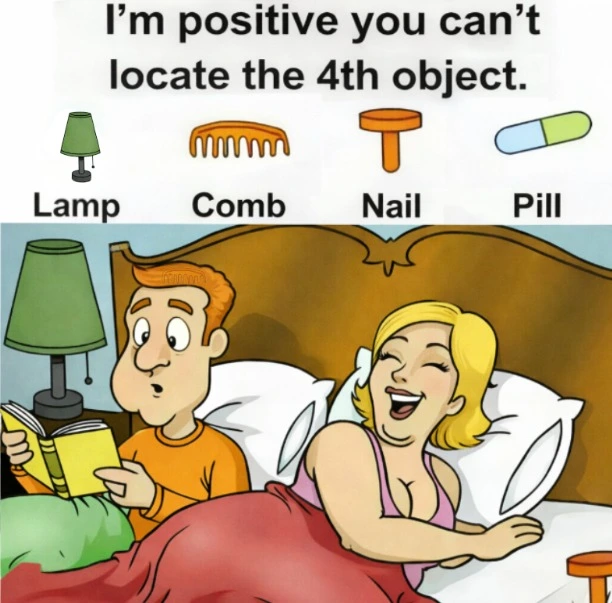
At first glance, this illustration feels familiar—just an ordinary bedroom scene. But hidden beneath its simplicity lies a clever challenge designed to test your observation skills. Hidden object puzzles like this transform everyday images into engaging brain teasers, where the goal is not just to look… but to truly see.
Somewhere in this scene are four objects: a lamp, a comb, a nail, and a pill. The question is—can you find them all?
The First Look Isn’t Enough
When you first look at the image, your brain quickly identifies the obvious elements: people, furniture, and the general setting. But hidden objects don’t reveal themselves that easily.
You might spot one or two items instantly, giving you confidence. Then suddenly… you get stuck. That’s where the real puzzle begins.
This is the moment where your perception shifts—from casual viewing to active searching.
The Art of Hiding in Plain Sight
The brilliance of this puzzle lies in how naturally the hidden objects blend into the scene.
- The lamp may not be where you expect it
- The comb could be part of a pattern
- The nail might be hidden in small details
- The pill is especially tricky to notice
Each one is designed to feel like it belongs, making it harder to spot.
Why Your Brain Struggles
Hidden object puzzles work because they challenge how your brain processes visuals. Instead of analyzing every detail, your mind simplifies what it sees.
That’s why you might:
- Miss small details
- Assume shapes are what they seem
- Overlook what’s right in front of you
To solve it, you need to slow down and question everything.
Simple Scene, Tricky Challenge
The scene is intentionally simple, which makes the hidden objects even harder to notice. With fewer distractions, your brain feels confident—but that confidence can be misleading.
The challenge isn’t complexity—it’s attention to detail.
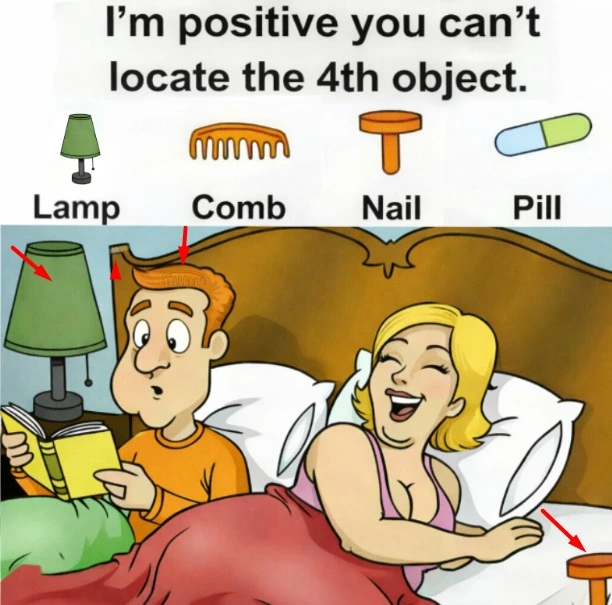
The Solution
If you’re struggling or just want to check your answers, don’t worry—I’ve got you covered. In this image, I’ll show you exactly where each of the four objects is hidden so you can see how cleverly they were placed.
Conclusion: The Joy of Looking Twice
This puzzle is a reminder that what we see at first glance is rarely the full picture. By slowing down and observing carefully, we begin to notice details we would normally ignore.
That’s what makes these challenges so satisfying—they reward patience, curiosity, and a second look.
So… did you find all four before checking the answer?