
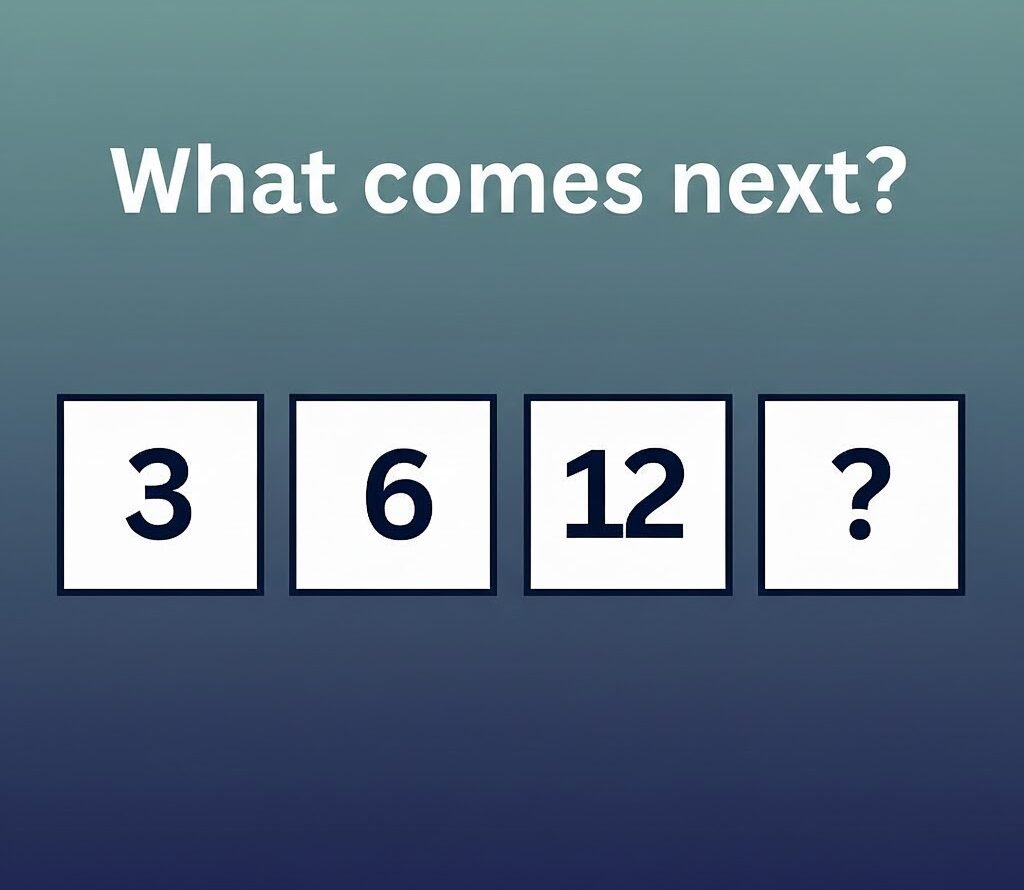
Puzzles don’t need to be complicated to make people stop, stare, and second-guess themselves. Sometimes the simplest number sequences create the most debate — especially when multiple patterns seem possible. Today’s brain teaser is a perfect example:
3, 6, 12, ?
At first glance, this sequence looks almost too easy. But the moment you ask people what comes next, the answers start to vary. Some jump to doubling, some see addition, others spot hidden patterns. So let’s break down the most common answers people give, why they think that way, and ultimately the correct solution.
💭 Possible Answer #1: “24”
This is by far the most common answer — and for good reason.
Many people notice that:
- 3 becomes 6 (×2)
- 6 becomes 12 (×2)
So naturally, the next step should be:
12 × 2 = 24
This thinking is clean, intuitive, and logical. Doubling sequences appear often in puzzle books and viral riddles, so the brain jumps straight into a simple exponential pattern. Most people stop here — and honestly, it makes perfect sense.
💭 Possible Answer #2: “21”
Another group sees something different. Instead of multiplication, they notice increasing addition:
- 3 + 3 = 6
- 6 + 6 = 12
So they assume the pattern continues with:
12 + 9 = 21
Where does the +9 come from?
Some solvers assume the number being added increases by 3 each time:
+3 → +6 → +9
Why do people think like this?
Because number sequences often step up gradually, and this pattern feels smooth and structured. The idea of adding a growing increment is common in IQ tests and math puzzles.
💭 Possible Answer #3: “18”
Some spot yet another pattern:
- Add 3 to get 6
- Add 6 to get 12
So the increments are doubling: 3, 6… and next would be 12.
12 + 12 = 24 (but some think the next increment is 6 again, leading to 18)
Why does this happen?
Because the mind sometimes “resets” patterns. Instead of seeing escalating steps, some people repeat the last known change.
🧠 Why People See Different Patterns
This puzzle reveals something fascinating about how the brain works:
1. We Fill in Patterns Automatically
Humans are wired to detect repetition. When numbers look familiar or clean, the mind quickly assumes the most straightforward rule — even if multiple rules fit.
2. Simple Sequences Can Have Multiple Valid Answers
Unless a pattern is explicitly defined, different logical approaches can lead to different results. That’s why puzzles like this spark so much debate.
3. People Rely on What They’ve Seen Before
Students who’ve done IQ tests often choose “24.”
People who enjoy arithmetic patterns might pick “21.”
Your background influences your interpretation.
✅ The Correct Answer: 24
Although several answers are possible, the most mathematically consistent and widely accepted pattern is:
Each number doubles.
3 → 6 → 12 → 24
It follows a clean geometric sequence, the simplest and strongest match to the given numbers.